盧梭自然發展教育與柏拉圖國家本位教育對108課綱之啟示
The Implications of Rousseau’s Natural Development Education and Plato’s State-Centered Education for the 2019 Curriculum Guidelines
蕭嘉賢;鄭淵全
Chia-Hsien Hsiao;Yuan-Chuan Cheng
Doi:10.6925/SCJ.202512_21(4).0001
Chia-Hsien Hsiao;Yuan-Chuan Cheng
Doi:10.6925/SCJ.202512_21(4).0001
| 所屬期刊: |
第21卷第4期 主編:國立暨南國際大學教育學院學士班教授兼副校長 楊洲松 |
|---|---|
| 系統編號: | vol083_01 |
| 主題: | 其它 |
| 出版年份: | 2025 |
| 作者: | 蕭嘉賢;鄭淵全 |
| 作者(英文): | Chia-Hsien Hsiao;Yuan-Chuan Cheng |
| 論文名稱: | 盧梭自然發展教育與柏拉圖國家本位教育對108課綱之啟示 |
| 論文名稱(英文): | The Implications of Rousseau’s Natural Development Education and Plato’s State-Centered Education for the 2019 Curriculum Guidelines |
| 共同作者: | |
| 最高學歷: | |
| 校院名稱: | |
| 系所名稱: | |
| 語文別: | 中文 |
| 論文頁數: | 32 |
| 中文關鍵字: | 自然發展教育;國家本位教育;108 課綱 |
| 英文關鍵字: | natural development education;state-centered education;2019 Curriculum Guidelines |
| 服務單位: | 國立清華大學教育與學習科技學系博士班博士生;臺中市沙鹿區鹿峰國民小學教師;國立清華大學教育與學習科技學系教授 |
| 稿件字數: | 23257 |
| 作者專長: | |
| 投稿日期: | 2025/04/15 |
| 論文下載: |  |
| 摘要(中文): | 本文旨在探討盧梭(Jean-Jacques Rousseau, 1712-1778)自然發展教育與柏拉圖(Plato, B.C. 429-B.C. 347)國家本位教育對 108 課綱之啟發。盧梭《愛彌兒:論教育》強調兒童中心、尊重天性;柏拉圖《理想國》聚焦國家利益,教育應服務國家。108 課綱所提倡之「全人教育」正是蘊含兩者思想之內涵。當今 VUCA (Volatile, Uncertain, Complex,& Ambiguous)時代面臨諸多挑戰與困難,應如何在個體發展與國家利益間取得平衡,並維持教育的初衷與人文精神?本文將基於兩者教育理念,對 108 課綱提出研究反思與建議:(一)兩者教育理念具互補性:兼具108 課綱「適性揚才」之理念和「終身學習」之精神,展現「全人教育」之圖像;(二)「部定課程」與「校訂課程」體現「個人與社會」、「地方與中央」之教育張力(三)以「自愛」為基礎的課程設計,引導健康的「虛榮之愛」,培養具理性「德性」之「公意」社會;(四)公正(equity)分配資源、平衡個體需求與集體價值;(五)童年期保護「自愛」與靈魂和諧發展,減少競爭壓力、青少年階段平衡「虛榮之愛」與陶冶「正義之德」;(六)強化數位素養、媒體識讀、國際教育、永續發展等議題,使其具全球競爭力。本文期能呼應未來全球化、永續發展及人工智慧數位浪潮,提升學生問題解決能力,實踐未來公民素養之「全人教育」圖像。 |
| 摘要(英文): | This study aims to explore the differences between the natural development-oriented education of Jean-Jacques Rousseau (1712~1778) and the state-centered education of Plato (B.C. 429- B.C. 347), and to analyze the implications for Taiwan’s Curriculum Guidelines of the 12-Year Basic Education (2019 Curriculum Guidelines). Emile, or On education by Rousseau emphasized a child-centered approach and reverence for nature, whereas The Republic by Plato focused on national interests, asserting that education should serve the state. In today’s VUCA (Volatile, Uncertain, Complex, and Ambiguous) world, education faces unprecedented challenges. How can we balance individual development with national interests, while preserving the original intention and humanistic spirit of education? This study proposes reflections and suggestions: 1. Embracing the complementarity of Rousseau and Plato’s educational philosophies: Embodying the spirit of “holistic education”. 2. “MOE-mandated curriculum” and “School-developed curriculum” reflect the educational tension between society and the individual. 3. Curriculum design should be based on “amour de soi”, guided by healthy “amour-propre”, and oriented toward the “general will” with rational “virtue”. 4. It is crucial to allocate social resources equitably and balance individual needs and collective values. 5. In childhood, it is essential to emphasize “amour de soi” and promote the harmonious development of the soul by reducing competitive pressures. In adolescence, it is important to balance “amour-propre” and cultivate the moral virtue of justice. 6. It is pivotal to strengthen digital literacy, media literacy, international education, and sustainable development to enhance global competitiveness. This study aspires to respond to future trends of globalization, sustainable development, and the digital revolution of artificial intelligence by enhancing students’ problem-solving abilities and realizing a vision of “holistic education” oriented toward the cultivation of future civic competence. |
| 參考文獻: |






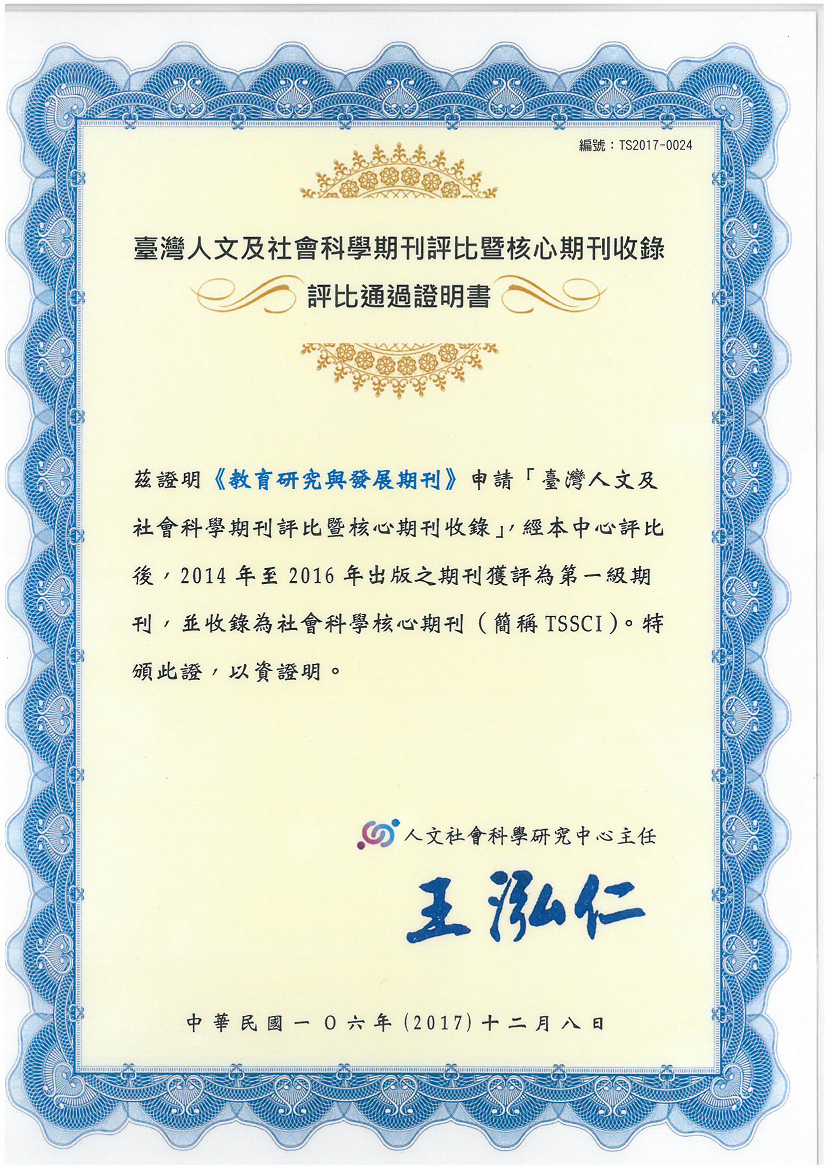 TSSCI 2017年評比證明書(第一級)

熱門期刊下載排行