
大學學院院長領導角色:從組織類型之觀點
The Leadership Role of University College Deans: A Perspective on Organizational Typology
楊家瑜
Chia Yu Yang
Doi:10.6925/SCJ.202509_21(3).0002
Chia Yu Yang
Doi:10.6925/SCJ.202509_21(3).0002
| 所屬期刊: |
第21卷第3期 主編:國立暨南國際大學教育學院學士班教授兼副校長 楊洲松 |
|---|---|
| 系統編號: | vol082_02 |
| 主題: | 課程與教學 |
| 出版年份: | 2025 |
| 作者: | 楊家瑜 |
| 作者(英文): | Chia Yu Yang |
| 論文名稱: | 大學學院院長領導角色:從組織類型之觀點 |
| 論文名稱(英文): | The Leadership Role of University College Deans: A Perspective on Organizational Typology |
| 共同作者: | |
| 最高學歷: | |
| 校院名稱: | |
| 系所名稱: | |
| 語文別: | 中文 |
| 論文頁數: | 44 |
| 中文關鍵字: | 中層管理;學術領導;新公共管理;學院組織類型 |
| 英文關鍵字: | middle management;academic leadership;new public management;NPM;organizational typology at college level |
| 服務單位: | 國立中正大學通識教育中心助理研究員 |
| 稿件字數: | 20580 |
| 作者專長: | |
| 投稿日期: | 2025/1/2 |
| 論文下載: |  |
| 摘要(中文): | 以國內外大學學院院長領導的相關文獻、組織效能,及Quinn的理論架構為基礎,本研究旨在探討在新公共管理思潮下,國內大學學院組織類型,進一步分析大學學院院長領導角色的現況。透過自編的問卷工具,以國內教師為範圍,依學校類型、地區別進行分層比例抽樣,再考量教育部學科分類標準(即人文、社會、科技),運用叢集抽樣方式分配各校所屬學院的教師樣本數。運用所回收的樣本資料,進行集群分析、區別分析及變異數分析。本研究發現在新公共管理思潮下,國內大學學院組織類型呈現混合治理模式,即以家族型、市場型為主。其次,不同學院組織類型中,院長所展現的領導角色皆以經紀者、協調者最明顯。呼應相關文獻,可知國內高等教教育治理架構中呈現有別於西方的臺灣獨特脈絡。本研究是國內少數在高等教育治理相關主題中,聚焦於大學學院院長領導,並採用實證研究分析,不僅瞭解國內大學內部治理在新公共管理思潮下,大學學院組織的類型,亦探討院長領導角色的現況。根據研究結果,可提供國內未來調整學院實體化政策、發展中層領導力架構之參考。此外,亦有助於學院院長釐清其角色、定位及中層領導力的重要性。 |
| 摘要(英文): | Grounded in relevant domestic and international literature on the leadership of university college deans both domestically and internationally, organizational effectiveness, and Quinns theoretical framework, this study explores the types of university college organizations in the context of New Public Management (NPM). It further analyzes the current state of the leadership roles of deans within Taiwanese universities. A self-developed questionnaire was administered to faculty members across universities in Taiwan. Stratified proportional sampling was conducted based on school type and region, and, following the Ministry of Education’s disciplinary classifications (humanities, social sciences, and technology), cluster sampling was used to allocate faculty samples from different colleges. The collected data were analyzed using cluster analysis, discriminant analysis, and analysis of variance (ANOVA). Findings indicate that, under NPM, Taiwanese university colleges exhibit a hybrid governance model, primarily characterized by clan- and market-oriented structures. Across different organizational types, deans most prominently demonstrate the roles of broker and coordinator. These results align with existing literature, highlighting a governance framework in Taiwanese higher education that is distinct from Western contexts. This study is among the few in Taiwan to empirically examine the leadership roles of university college deans within the broader discourse on higher education governance. The findings not only enhance understanding of organizational typologies and governance structures under NPM but also provide valuable implications for future adjustments to college corporatization policies and the development of middle-level leadership frameworks. Furthermore, the results can assist deans in clarifying their roles, positioning, and recognizing the importance of middle-level leadership. |
| 參考文獻: | 吳明隆、?金堂(2012)。SPSS 與統計應用分析。五南。 周麗芳(2002)。華人組織中的關係與社會網絡。本土心理學研究,8,175-227。 https://doi.org/10.6254/IPRCS.200212_(18).0004 邱浩政(2018)。量化研究法(一):研究設計與資料分析。雙葉。 國立中正大學(2024)。國立中正大學組織規程(2024 年 3 月 29 日)。2024 年 12 月 25 日,取自國立中正大學人事室,https://person.ccu.edu.tw/p/412-1015- 2010.php?Lang=zh-tw#A1 國立成功大學(2023)。國立成功大學組織規程(2023 年 8 月 1 日)。2024 年 12 月 25 日,取自國立成功大學研究發展處,https://ord.ncku.edu.tw/article- organize.html 國立清華大學(2023)。國立清華大學組織規程(2023 年 11 月 30 日)。2024 年 12 月 25 日,取自國立清華大學秘書處,https://secretary.site.nthu.edu.tw/p/412-1070-15367.php?Lang=zh-tw 國立臺灣大學(2024)。國立臺灣大學組織規程(2024 年 1 月 10 日)。2024 年 12 月 25 日,取自國立臺灣大學人事室,https://www.personnel.ntu.edu.tw/ News_n_7_sms_9052__CSN_1830.html 國立臺灣科技大學(2023)。國立臺灣科技大學組織規程(2023 年 11 月 14 日)。 2024 年 12 月 25 日,取自國立臺灣科技大學,https://www.ntust.edu.tw/p/404- 1000-76376.php?Lang=zh-tw 教育部(2005 年 12 月 13 日修正)。大學法(2024 年 7 月 30 日)。立法院法律系 統。https://lis.ly.gov.tw/lglawc/lawsingle?0^621803C4036068661803C0E56060669823C4437260629873C403 教育部(2014)。教育部人才培育白皮書。https://ws.moe.edu.tw/001/Upload/3/ RelFile/6315/6919/ 教育部人才培育白皮書 .pdf 教育部(2018)。學院實體化是辦計畫—以「院」開課,唸大學更彈性。高教創 新,20,16-19。 教育部(2019 年 12 月 11 日修訂)。大學法。全國法規資料庫。https://law.moj. gov.tw/LawClass/LawAll.aspx?pcode=H0030001 教育部(2020 年 7 月 14 日增訂)。大學法施行細則。全國法規資料庫。https:// law.moj.gov.tw/LawClass/LawOldVer.aspx?pcode=H0030028&lnndate=20200714 &lser=001 Bassaw, B. (2010). Determinants of successful deanship. Medical Teacher, 32(12), 1002-1006. https://doi.org/10.3109/0142159X.2010.497821 Boyko, L., & Jones, G. A. (2010). The roles and responsibilities of middle management(chairs and deans) in Canadian universities. In V. L. Meek, L. Goedegebuure, R.Santiago, & T. Carvalho (Eds.), The changing dynamics of higher education middle management. Higher Education Dynamics, vol 33. (pp. 83-102). Springer. https://doi.org/10.1007/978-90-481-9163-5_5 Braun, D., Benninghoff, M., Ramuz, R., & Gorga, A. (2014). Interdependency management in universities: A case study. Studies in Higher Education, 40(10), 1829-1843. https://doi.org/10.1080/03075079.2014.914913 Bray, N. J. (2012). Follow the code: Rules or guidelines for academic deans’ behavior? New Directions for Higher Education, 2012(160), 19-28. https://doi.org/10.1002/he.20033 Broucker, B., De Wit, K., & Verhoeven, J. C. (2017). Higher education research: Looking beyond new public management. In J. Huisman & M. Tight (Eds.), Theory and method in higher education research (Vol. 3, pp. 21-38). Emerald. https://doi.org/10.1108/S2056-375220170000003002 Cameron, K. S., & Freeman, S. J. (1991). Cultural congruence, strength, and type: Relationships to effectiveness. Organizational Change and Development, 5, 23-58. Carvalho, T., & Santiago, R. (2010). New public management and ‘middle management’: How do deans influence institutional policies? In V. L. Meek, L. Goedegebuure, R. Santiago, & T. Carvalho (Eds.), The changing dynamics of higher education middle management (pp. 165-196). Springer. https://doi.org/10.1007/978-90-481-9163-5_9 Catacutan, M. R. G., & de Guzman, A. B. (2016). Bridge over troubled water: Phenomenologizing Filipino college deans’ ethical dilemmas in academic administration. Educational Management Administration & Leadership, 44(3), 491-510. https://doi.org/10.1177/1741143214558579 Chan, S. J., Yang, C. C., & Lo, W. Y. (2023). Adopting neoliberal values in Taiwan’s higher education governance: a hybridisation process. Discourse: Studies in the Cultural Politics of Education, 44(3), 425-440. https://doi.org/10.1080/01596306.2023.2200078 Cheng, Z., & Zhu, C. (2023). Leadership styles of mid-level educational leaders perceived by academic members: An exploratory study among Chinese universities. Research in Educational Administration & Leadership, 8(4), 762-794. https://doi.org/10.30828/real.1255643 Davies, J. (2016). Are business school deans doomed? The global financial crisis, Brexit and all that. Journal of Management Development, 35(7), 901-915. https://doi.org/10.1108/JMD-09-2014-0114 Davies, J., & Thomas, H. (2009). What do business school deans do? Insights from a UK study. Management Decision, 47(9), 1396-1419. https://doi.org/10.1108/00251740910995620 de Boer, H., Enders, J., & Schimank, U. (2007). On the way towards new public management? The governance of university systems in England, the Netherlands, Austria, and Germany. In D. Jansen (Ed.), New forms of governance in research organizations (pp. 137-152). Springer. https://doi.org/10.1007/978-1-4020-5831-8_5 de Boer, H., Goedegebuure, L., & Meek, V. L. (2010). The changing nature of academic middle management: A framework for analysis. In V. L. Meek, L. Goedegebuure, R. Santiago, & T. Carvalho (Eds.), The changing dynamics of higher education middle management. Higher Education Dynamics, vol 33. (pp. 229-241). Springer. https://doi. org/10.1007/978-90-481-9163-5_12 de Guzman, A. B., & Hapan, M. F. Z. (2013). It takes two to tango: Phenomenologizing collaborative mindset of Filipino academic deans. Asia-Pacific Education Researcher, 22(3), 315-326. https://doi.org/10.1007/s40299-012-0056-7 Del Favero, M. (2005). The social dimension of academic discipline as a discriminator of academic deans’ administrative behaviors. The Review of Higher Education, 29(1), 69-96. https://doi.org/10.1353/rhe.2005.0066 Donina, D., & Paleari, S. (2018). New public management: Global reform script or conceptual stretching? Analysis of university governance structures in the Napoleonic administrative tradition. Higher Education, 78, 193-219. https://doi.org/10.1007/s10734-018-0338-y Falls, A., & Allen, S. (2020). Leader-to-follower transitions: Flexibility and awareness. Journal of Leadership Studies, 14(2), 24-37. https://doi.org/10.1002/jls.21696 Frenkel, S. J. (2021). Embedded in two worlds: The university academic manager’s work, identity and social relations. Educational Management Administration & Leadership, 51(5), 1087-1104. https://doi.org/10.1177/17411432211027643 Fumasoli, T., & Hladchenko, M. (2024). Strategic management in higher education: Conceptual insights, lessons learned, emerging challenges. Tertiary Education and Management, 29(3), 331-339. https://doi.org/10.1007/s11233-024-09134-5 Gallos, J. V. (2002). The dean’s squeeze: The myths and realities of academic leadership in the middle. Academy of Management Learning & Education, 1(2), 174-184. https://doi.org/10.5465/AMLE.2002.8509367 Geschwind, L., Aarrevaara, T., Berg, L. N., & Lind, J. K. (2019). The changing roles of academic leaders: Decision-making, power, and performance. In L. Geschwind, T. Aarrevaara, L. N. Berg, & J. K. Lind (Eds.), Reforms, organizational change and performance in higher education: A comparative account from the Nordic countries (pp. 181-210). Palgrave Macmillan. https://doi.org/10.1007/978-3-030-11738-2_6 Guyottot, O., & Thelisson, A. S. (2023). Coping with paradoxical demands: The dual position of deans in French business schools. Studies in Higher Education, 49(8), 1360-1380. https://doi.org/10.1080/03075079.2023.2265405 Hagerer, I. (2019). Universities act differently: Identification of organizational effectiveness criteria for faculties. Tertiary Education and Management, 25(3), 273-287. https://doi.org/10.1007/s11233-019-09031-2 Hamlin, R. G., & Patel, T. (2015). Perceived managerial and leadership effectiveness within higher education in France. Studies in Higher Education, 42(2), 292-314. https://doi.org/10.1080/03075079.2015.1045480 Hassan, A., Gallear, D., & Sivarajah, U. (2018). Critical factors affecting leadership: A higher education context. Transforming Government: People, Process and Policy, 12(1), 110-130. https://doi.org/10.1108/TG-12-2017-0075 Homburg, V., Pollitt, C., & van Thiel, S. (2007). Introduction. In C. Pollitt, S. van Thiel, & V. Homburg (Eds.), New public management in Europe (pp. 1-9). Palgrave Macmillan. https://doi.org/10.1057/9780230625365_1 Huang, F., Daizen, T., & Kim, Y. (2020). Changes in Japanese universities governance arrangements 1992–2017. Studies in Higher Education, 45(10), 2063–2072. https://doi.org/10.1080/03075079.2020.1823642 Kaneko, M. (2009). Incorporation of national universities in Japan: Design, implementation and consequences. Asia Pacific Education Review, 10(1), 59-67. https://doi.org/10.1007/s12564-009-9004-5 Lavigne, E. (2018). The collegial and managerial roles and qualifications of Canadian university deans. Studies in Higher Education, 44(12), 2304-2317. https://doi.org/10.1080/03075079.2018.1496409 Lynch, K., Grummell, B., & Devine, D. (2012). New managerialism as a political project:The Irish case. Palgrave Macmillan. https://doi.org/10.1057/9781137007230 Maddock, L. C. (2023). Academic middle leaders, middle leading and middle leadership of university learning and teaching: A systematic review of the higher education literature. Journal of Higher Education Policy and Management, 45(4), 357-392. https://doi.org/10.1080/1360080X.2022.2160888 Marginson, S. (2011). Higher education in East Asia and Singapore: Rise of the Confucian model. Higher Education, 61(5), 587-611. https://doi.org/10.1007/s10734-010-9384-9 Mesfin, A., & Mengistu, M. (2024). Destructive leadership behavior and organizational effectiveness in college of teacher education. International Journal of Leadership in Education, 1-12. https://doi.org/10.1080/13603124.2023.2298207 Mignot-Gerard, S. (2010). Presidents and deans in French universities: A collective approach to academic leadership. In V. Meek, L.Goedegebuure, R. Santiago, & T. Carvalho (Eds.), The changing dynamics of higher education middle management (pp. 119-143). Springer. https://doi.org/10.1007/978-90-481-9163-5_7 Montez, J. M., Wolverton, M., & Gmelch, W. H. (2002). The roles and challenges of deans. The Review of Higher Education, 26(2), 241-266. https://doi.org/10.1353/rhe.2002.0034 Pham, T. V., Nghiem, T. T., Nguyen, L. M. T., Mai, T. X., & Tran, T. (2019). Exploring key competencies of mid-level academic managers in higher education in Vietnam. Sustainability, 11(23), 6818. https://doi.org/10.3390/su11236818 Quinn, R. E. (1988). Beyond rational management: Mastering the paradoxes and competing demands of high performance. Jossey-Bass. Quinn, R. E., Bright, D. S., Sturm, R. E. (2007). Becoming a master manager: A competing values approach. Wiley. Rosser, V. J., Johnsrud, L. K., & Heck, R. H. (2003). Academic deans and directors: Assessing their effectiveness from individual and institutional perspectives. The Journal of Higher Education, 74(1), 1-25. https://doi.org/10.1353/jhe.2003.0007 Seale, O., & Cross, M. (2015). Leading and managing in complexity: the case of South African deans. Studies in Higher Education, 41(8), 1514-1532. https://doi.org/10.1080/03075079.2014.988705 Sharma, S., Amir, S. D. S., Veeriah, J., & Kannan, S. (2016). Leadership behavior of deans and its impact on effectiveness for quality in a high-ranking university. Education and Science, 41(184), 49-58. https://doi.org/10.15390/EB.2016.6071 Shin, J. C. (2012). Higher education development in Korea: Western university ideas, Confucian tradition, and economic development. Higher Education, 64(1), 59-72. https://doi.org/10.1007/s10734-011-9475-6 Siddique, A., Aslam, H. D., Khan, M., & Fatima, U. (2011). Impact of academic leadership on faculty’s motivation and organizational effectiveness in higher education system. International Journal of Business and Social Science, 2(8), 184-191. Teece, D. J. (2009). Dynamic capabilities and strategic management: Organizing for innovation and growth. Oxford University Press. Teece, D. J., Pisano, G., & Shuen, A. (2004). Dynamic capabilities and strategic management. In M. L. Tushman & P. Anderson (Eds.), Managing strategic innovation and change (pp. 308-332). Oxford University Press. Tjeldvoll, A. (2011). Change leadership in universities: the Confucian dimension. Journal of Higher Education Policy and Management, 33(3), 219-230. https://doi.org/10.1080/1360080X.2011.564997 Vuori, J. (2014). Enacting the common script: Management ideas at Finnish universities of applied sciences. Educational Management Administration & Leadership, 43(4), 646-660. https://doi.org/10.1177/1741143214523016 |










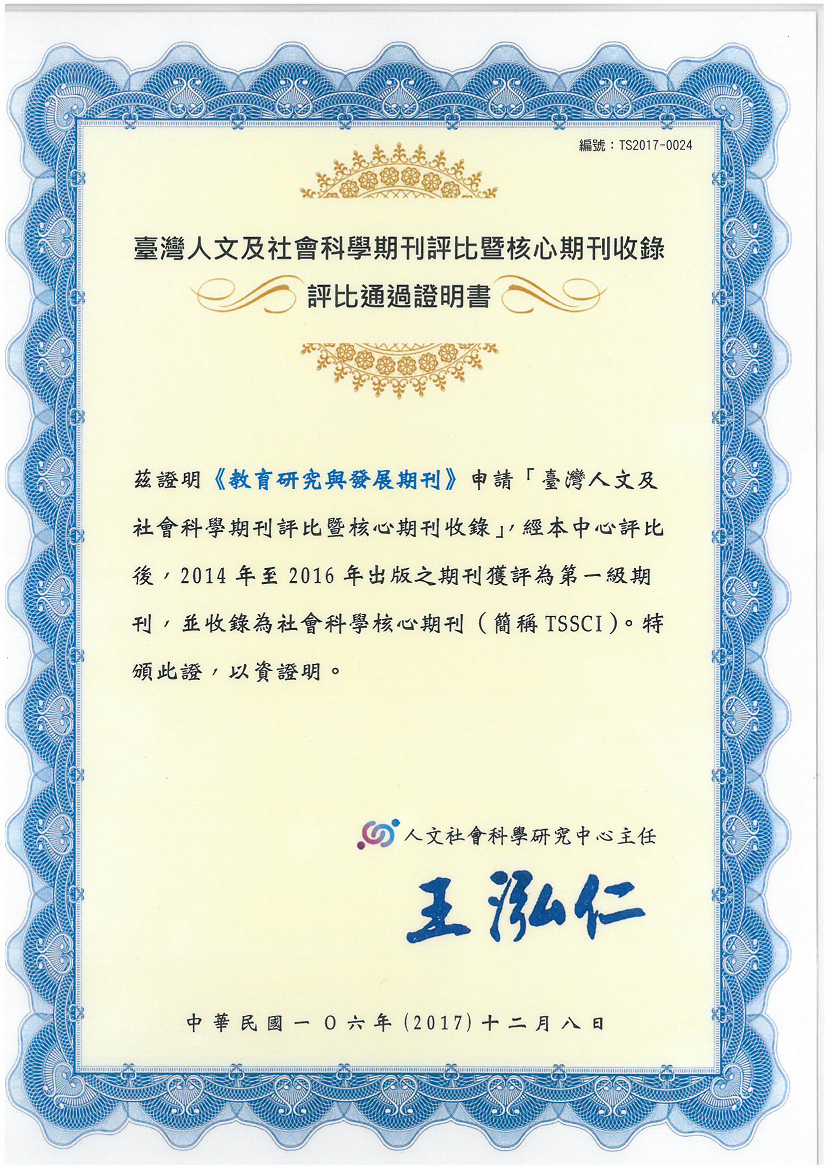 TSSCI 2017年評比證明書(第一級)
熱門期刊下載排行