
優勢本位領導培訓與實施對國小校長優勢本位領導力影響之研究
The Impact of Strengths-Based Leadership Training and Implementation on the Strengths-Based Leadership Competencies of Elementary School Principals
丁一顧;莊念青;賴素卿
Yi-Ku Ting;Nien-Ching Chuang;Su-Ching Lai
Doi:10.6925/SCJ.202509_21(3).0003
Yi-Ku Ting;Nien-Ching Chuang;Su-Ching Lai
Doi:10.6925/SCJ.202509_21(3).0003
| 所屬期刊: |
第21卷第3期 主編:國立暨南國際大學教育學院學士班教授兼副校長 楊洲松 |
|---|---|
| 系統編號: | vol082_03 |
| 主題: | 教育政策與制度 |
| 出版年份: | 2025 |
| 作者: | 丁一顧;莊念青;賴素卿 |
| 作者(英文): | Yi-Ku Ting;Nien-Ching Chuang;Su-Ching Lai |
| 論文名稱: | 優勢本位領導培訓與實施對國小校長優勢本位領導力影響之研究 |
| 論文名稱(英文): | The Impact of Strengths-Based Leadership Training and Implementation on the Strengths-Based Leadership Competencies of Elementary School Principals |
| 共同作者: | |
| 最高學歷: | |
| 校院名稱: | |
| 系所名稱: | |
| 語文別: | 中文 |
| 論文頁數: | 40 |
| 中文關鍵字: | 優勢本位領導;優勢本位領導力;國小校長 |
| 英文關鍵字: | strengths-based leadership;strengths-based leadership competencies;elementary school principals |
| 服務單位: | 臺北市立大學教育行政與評鑑研究所特聘教授;國立屏東大學教育學系助理教授;國立臺灣科技大學語言中心講師 |
| 稿件字數: | 17888 |
| 作者專長: | |
| 投稿日期: | 2025/3/12 |
| 論文下載: |  |
| 摘要(中文): | 本研究旨在探究國小初任校長優勢本位領導培訓與實施的成效,研究採不等組前後設計準實驗研究法、問卷調查法、以及焦點團體訪談法。以38位國小初任校長為研究對象,其中,19 位實驗組校長接受校長優勢本位領導之培訓,而對照組19位校長則否,並於實驗前後測量校長優勢本位領導力,藉以瞭解優勢本位領導培訓的效果。而焦點團體訪談,則以滾雪球抽樣從實驗組抽取 10 位校長及其學校共 14 教師為訪談對象,藉以深入瞭解優勢本位領導培訓與實施的成效。研究結果為:(一)國民小學初任校長具有良好的優勢本位領導力;(二)校長優勢本位領導的培訓與實施,能有效提升國民小學初任校長「執行力、關係建立力、影響力、策略思考力、希望營造力」之優勢本位領導力。根據研究結論,本研究提出相關建 議,俾供實務及未來研究之參考。 |
| 摘要(英文): | The purpose of this study is to examine the effects of strengths-based leadership training and implementation on elementary school principals. A nonequivalent control group quasi-experimental design was adopted, supplemented with surveys and focus group interviews. A total of 38 newly appointed elementary school principals participated in the quasi- experimental design, with 19 assigned to the treatment group, which received strengths-based leadership training, and 19 to the control group, which did not. Principals’ strengths-based leadership competencies were measured before and after the intervention to evaluate program effectiveness. In addition, focus group interviews were conducted using snowball sampling, selecting 10 principals from the treatment group along with 14 teachers from their respective schools. The purpose was to gain deeper insights into the effectiveness of the strengths-based leadership training and its implementation. The main findings of this study are as follows: (1)newly appointed principals generally demonstrated solid strengths-based leadership competencies; and (2) the training and implementation significantly enhanced competencies in executing, relationship building, influencing, strategic thinking, and hope-building. Based on these findings, the study offers recommendations for practice and directions for future research. |
| 參考文獻: | 巴頓(Patton, M. Q.)(1995)。質的評鑑與研究(吳芝儀、李奉儒,譯)。桂冠。 (原著出版於 1990) 王文科(1993)。教育研究法。五南。 王世璋(2006)。校長轉型領導、學校組織學習與學校組織創新關係之研究。國民 教育研究學報,16,27-53。 吳明清(1991)。教育研究—基本觀念與方法分析。五南。 柯華葳、曾世杰(2014)。教育改革是永遠的進行式:教改 20 年有感。國家教育 研究院電子期刊,101。https://reurl.cc/W0Y5dk 秦夢群、吳勁甫(2009)。國中校長轉型領導、學校組織健康與組織效能關係之研 究:中介效果模式之檢證。當代教育研究季刊,17(3),83-124。https://doi. org/10.6151/CERQ.2009.1703.03 張慶勳(2006)。學校組織文化與領導。五南。 郭生玉(1995)。心理與教育研究法。精華。 黃麗鈴(2019)。從社會科學研究典範質量之辯探析混合研究。臺灣教育評論月 刊,8(6),163-177。 蔡進雄(2005)。學校領導理論研究。師大書苑。 邁爾斯、休伯曼(Miles, M. B., & Huberman, A. M.)(2005)。質性研究資料分析(張芬芬,譯)。雙葉書廊。(原著出版於 1994 年) Akter, R., Hossain, M. A., Al-Amin, M., Alam, M. A., & Uddin, M. A. (2021). Empirical study on strength-based leadership and sustainable employment in a mediated model. Bangladesh Economia, 70-81. Aljofan, A., Faleh, R., & Alrofiai, F. (2024). Skill obsolescence in the digital age: Grit, strength-based leadership approach, and employee’s career adaptability in multinational corporations. Open Journal of Business and Management, 12, 3395-3416. Bass, B. M., & Avolio, B. J. (1990). Transformational leadership development: Manual for the multifactor leadership questionnaire. Consulting Psychologists. Brun, P. H., Cooperrider, D., & Ejsing, M. (2016). Strengths-based leadership handbook. Crown. Buckingham, M., & Clifton, D. O. (2000). Now, discover your strengths. Free. Burkus, D. (2011). Building the strong organization: Exploring the role of organizational design in strengths-based leadership. Journal of Strategic Leadership, 3(1), 54-66. Cameron, K. (2012). Positive leadership: Strategies for extraordinary performance. Berrett-Koehler. Chang, L. (1994). A psychometric evaluation of 4-point and 6-point Likert-type scales. Applied Psychological Measurement, 18(3), 205-215. https://doi.org/10.1177/014662169401800302 Chu, X., Ding, H., Zhang, L., & Li, Z. (2022). Strengths-based leadership and turnover intention: The roles of felt obligation for constructive change and job control. Frontiers in Psychology, 13, 786551. https://doi.org/10.3389/fpsyg.2022.786551 Corey, G. (2013). Theory and practice of counseling and psychotherapy. Brooks/Cole. Ding, H., & Yu, E. (2021). Strengths-based leadership and employee psychological well-being: A moderated mediation model. Journal of Career Development, 49(5), 1108-1121. https://doi.org/10.1177/08948453211018807 Ding, H., Liu, J., & Yu, E. (2024). How and when do strengths work? The effect of strengths-based leadership on follower career satisfaction. Personnel Review, 53(6), 1392-1407.https://doi.org/10.1108/PR-07-2022-0485 Ding, H., Yu, E., & Li, Y. (2020). Strengths-based leadership and its impact on task performance: A preliminary study. South African Journal of Business Management,51(1), a1832. https://doi.org/10.4102/sajbm.v51i1.1832 Dronnen, M. (2022). Positive leadership: Using positive psychology for a better workplace culture. Springer. https://doi.org/10.1007/978-3-031-10816-7 Finn, R. H. (1972). Effect of some variations in rating scale characteristics on the means and reliabilities of ratings. Educational and Psychological Measurement, 32(2), 255-265. https://doi.org/10.1177/001316447203200203 Forouhar, M., Hoveida, R., Jamshidian, A., & Ghanenia, M. (2021). The effect of strengths-based leadership on job crafting with mediating role of psychological capital and learning agility. Human Resources Management in Oil Industry, 12(47), 92-111. Gay, L. R. (1987). Educational research: Competencies for analysis and application (3rd ed.). Merrill. Hennink, M. M., Kaiser, B. N., & Marconi, V. C. (2017). Code saturation versus meaning saturation: How many interviews are enough? Qualitative Health Research, 27(4), 591-608. https://doi.org/10.1177/1049732316665344 House, E. R. (1990). An ethics of qualitative field studies. In E. G. Guba (Ed.), The paradigm dialog (pp. 158-164). Sage. Jingwa, L. I. (2019). A case of positive teacher leadership: Positive deviance in a Canadian high school (Unpublished master’s thesis). University of Saskatchewan. Key-Roberts, M. (2014). Strengths-based leadership theory and development of subordinate leaders. Military Review, 94(2), 4-13. Key-Roberts, M., & Budreau, M. (2012). Applications of strengths-based leadership theory for the U.S. Army. Army Research Institute for the Behavioral and Social Sciences. Linley, P., Govindji, R., & West, M. (2007). Positive psychology approaches to public services leadership: An introduction to strengths-based leadership. International Journal of Leadership in Public services, 3(4), 44-55. https://doi.org/10.1108/17479886200700029 Liu, Q., & Tong, Y. (2022). Employee growth mindset and innovative behavior: The roles of employee strengths use and strengths-based leadership. Frontiers in Psychology, 13, 814154. https://doi.org/10.3389/fpsyg.2022.814154 Luthans, F., & Avolio, B. J. (2003). Authentic leadership: A positive developmental approach. In K. S. Cameron, J. E. Dutton, & R. E. Quinn (Eds.), Positive organizational scholarship (pp. 241-261). Berrett-Koehler. Luthans, F., & Youssef, C. (2004). Human, social, and now positive psychological capital management: Investing in people for competitive advantage. Organizational Dynamics, 33(2), 143-160. https://doi.org/10.1016/j.orgdyn.2004.01.003 Luthans, F., Norman, S. M., Avolio, B. J., & Ivey, J. B. (2008). The mediating role of psychological capital in the supportive organizational climate–employee performance relationship. Journal of Organizational Behavior, 29(2), 219-238. https://doi.org/10.1002/job.507 MacKie, D. J. (2013). The effectiveness of strength-based executive coaching in enhancing transformational leadership (Unpublished doctoral dissertation). University of Leicester. MacKie, D. J. (2014). The effectiveness of strength-based executive coaching in enhancing full range leadership development: A controlled study. Consulting Psychology Journal: Practice and Research, 66(2), 118-137. https://doi.org/10.1037/cpb0000005 MacKie, D. J. (2016). Strength-based leadership coaching in organizations: An evidence-based guide to positive leadership development. Kogan Page. McCarron, G. P., & Yamanaka, A. (2023). Effectiveness of a strengths-based leadership coaching program for women. Journal of Leadership Education, 22(1), 38-50. https://doi.org/10.12806/V22/I1/R9 Mind Tools Editorial Team. (2016). Strengths-based leadership: Understanding strengths and weaknesses. https://www.mindtools.com/pages/article/strengths-based-leadership.htm Mind Tools Editorial Team. (2019). Strengths-based leadership: Focus on your team’s strengths to build better teams. https://www.mindtools.com/pages/article/strengths-based-leadership.htm Petrone, C. G., Luzynsk, C., Petrone, A. B., Holmes, M. H., Dagen, A. S., & Lockman, J. A. (2023). Effectiveness of a strength-based leadership coaching program for women. Journal of Leadership Education, 22(1), 149-161. https://doi.org/10.12806/V22/I1/R9 Psencik, K. (2019). Coaching principals is calling and commitment. Learning Professional, 40(5), 10-12. Rath, T., & Conchie, B. (2008). Strengths based leadership: Great leaders, teams, and why people follow. Gallup. ath, T., & Conchie, B. (2009). Strengths based leadership: Great leaders, teams, and why people follow. Gallup. Ruethaivanich, K., & Scott, A. (2017). The impact of an organization development intervention on the strength-based leadership behaviors of team leaders and team members: A case study in the health systems division of Philips Thailand. ABAC ODI Journal Vision. Action. Outcome, 4(1), 57-77. Seligman, M. E. P. (2002). Authentic happiness. Free. Seligman, M. E. P., & Csikszentmihalyi, M. (2000). Positive psychology: An introduction. American Psychologist, 55(1), 5-14. https://doi.org/10.1037/0003-066X.55.1.5 Shutt, T. L. (2023). An examination of conflict resolution in dispersed organizations using strengths-based leadership (Unpublished doctoral dissertation). Abilene Christian University. Sieber, J. E. (1992). Planning ethically responsive research. Sage. Stollberger, J., Las Heras, M., Rofcanin, Y., & Bosch, M. J. (2019). Serving followers and family? A trickle-down model of how servant leadership shapes employee work performance. Journal of Vocational Behavior, 112, 158-171. https://doi.org/10.1016/j.jvb.2019.02.003 Sutton, J. (2021). Strength-based leadership & the traits of successful leaders. https://www.212-careers.com/wp-content/uploads/2022/09/Strength-based-Leadership-The-Traits-of-Successful-Leaders.pdf Uddin, M. A., Mahmood, M., Ostrovskiy, A., & Hwang, H. J. (2021). Can social networks improve user subjective wellbeing: Role of passion and personality traits. Journal of Global Information Management, 29(4), 53-77. https://doi.org/10.4018/JGIM.20210701.oa3 van Vianen, A. E. M., & De Dreu, C. K. W. (2001). Personality in teams: Its relationship to social cohesion, task cohesion, and team performance. European Journal of Work and Organizational Psychology, 10(2), 97-120. https://doi.org/10.1080/13594320143000573 Wang, J., van Woerkom, M., Breevaart, K., Bakker, A. B., & Xu, S. (2023). Strengths-based leadership and employee work engagement: A multi-source study. Journal of Vocational Behavior, 142, 103859. https://doi.org/10.1016/j.jvb.2023.103859 Youssef, C. M., & Luthans, F. (2012). Positive global leadership. Journal of World Business, 47, 539-547. https://doi.org/10.1016/j.jwb.2012.01.007 |










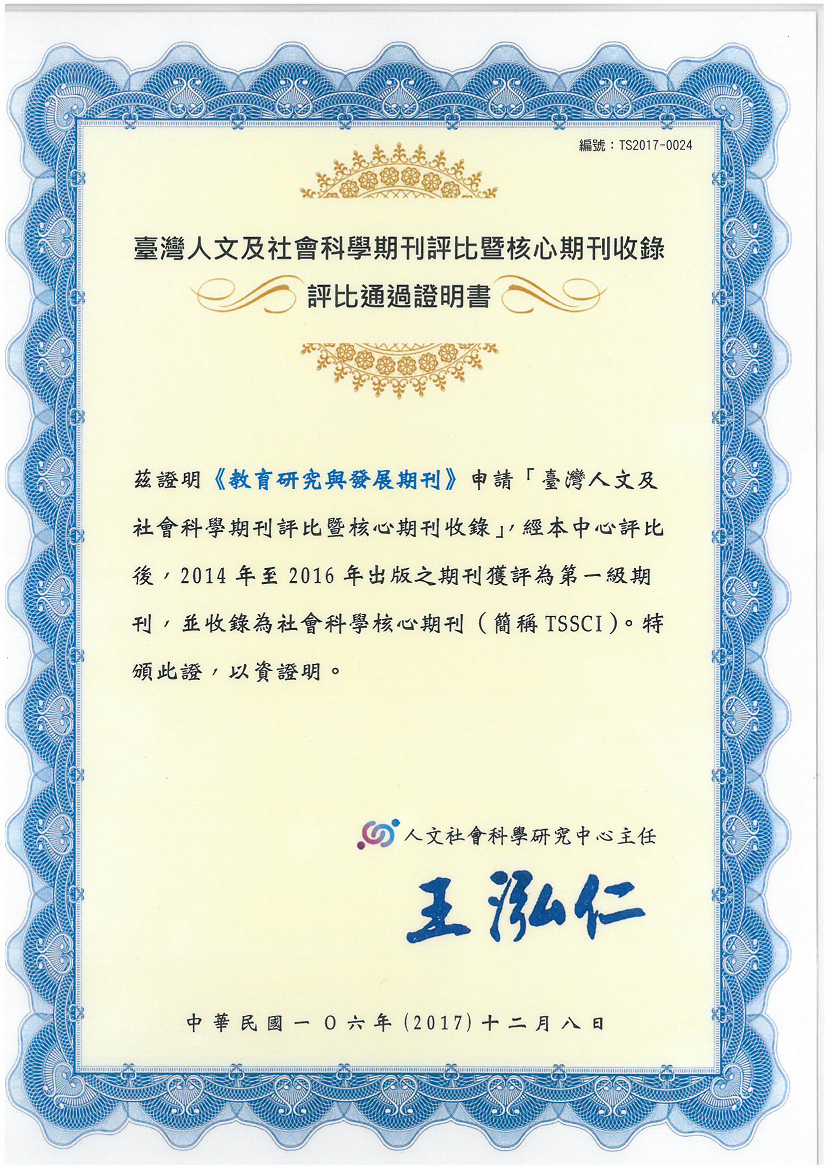 TSSCI 2017年評比證明書(第一級)

熱門期刊下載排行